Showing posts with label photographs. Show all posts

Wednesday, December 7, 2011

Twelve Days of Christmas Books: Collectible


Visit Dawsons' Bookshop online for rare books, particularly art, photography, and So-Cal/Western Americana history, and for awesome fine art photography. Seriously cool stuff. If you are not sure what you're looking for, sign up to receive the Dawsons' emails right away and you will receive periodic highlights from the collection for sale (not too many and always intriguing; you'll be glad to find these in your inbox).

There are offerings to suit most wallets. From more humbly fascinating items like Marcia Rittenhouse Wynn's turn-of the century stories set in the Upper Mojave Desert in a first edition (1945) with a gorgeous screenprinted cover (above), to "the post-Provoke masterpiece of Japanese photobooks," Masahisa Fukase's Karasu (Ravens) (below).


Proprietor/curator Michael Dawson also offers museum quality art photographs. Photographers represented range from the iconic, including Ansel Adams, to deserving lesser-knowns. Currently the Web site features the Sanford H. Roth collection; Roth moved from New York to Paris where he fell in with and photographed the culturati who would become lifelong friends, including Colette, Picasso, and Cocteau. Roth went on to photograph film stars in Hollywood and Eurpope, becoming famous for his portraits of James Dean.

Bastille day parade - 1950-55. Sanford H. Roth

Tuesday, December 6, 2011

Twelve Days of Christmas Books: Photography

Timothy H. O’Sullivan, Black Cañon, Colorado River, From Camp 8, Looking, Above, 1871, Albumen print, Library of Congress, Prints and Photographs Division. Check out the Art Tattler International Web site for a great preview.


Day one in twelve days of books from my wishlist.

Two gorgeous photography books available in the Art Institute gift shop, good for a destination shopping trip.

Check out the exhibit: Timothy H. O'Sullivan: The King Survey Photographs. Then pick up the book: Framing the West: The Survey Photographs of Timothy H. O'Sullivan for any fans of photography generally, history, Western Americana. General book and art lovers should find interest in O'Sullivan's photos too; much of his work finds men (and their essentials and accoutrements for survival and exploration) dwarfed within awesome, overwhelming landscapes, beautiful, certainly, and the images are charged with a current of foreboding. Both the "pure" landscapes and views incorporating the human form similarly suggest stories and spark the imagination.

You can order direct from Yale Univ. Press too.


Richard Misrach is a longtime favorite. Misrach's 2010 book Destroy This Memory looks at post-Katrina New Orleans. Misrach's eye is unique, his technique is dropdead gorgeous (let's just say he is considered responsible for "bringing color photography back"), and his subjects are meat and gristle, so his books are all substantial, worth the investment and deserving permanent shelfspace, as the images bear ongoing examination.

In his Modern Art Notes for the Artinfo blog, Tyler Green describes Misrach's gestalt for his Katrina book: "Misrach’s book focuses not on the totality of the devastation but on one way New Orleanians responded to it. . . . New Orleanians spray-painted messages on their homes, cars and propped-up boards of plywood. The graffiti are warnings, announcements, pleas and even sly jokes shared with neighbors, government, city officials and neighbors. They are among New Orleanians’ first written responses to their hell."

 
According to Green: "Misrach didn’t just make his pictures into a book, he printed them and gifted full sets of prints to five museums that serve as storehouses of our visual record of ourselves and our culture: the Museum of Modern Art, the National Gallery, the MFA Houston, SFMOMA and the New Orleans Museum of Art.  Misrach is also donating the royalties from book sales to the Make it Right Foundation, which is active in the Lower Ninth Ward of New Orleans. (Readers may also click here to give to Make it Right.)"

If you're not in Chicago, or you can't make a visit to the Art Insitutitue, Destroy This Memory is offered at a nice sale price via the publisher at: Aperture Foundation (while you're there, if you subscribe to the magazine, at a 50% discount, you get a free copy of Aperture's Masters of Photography series: Paul Strand with your subscription). 
“I’ve come to believe that beauty can be a very powerful conveyor of difficult ideas.”—Richard Misrach 
(If you do make it to the museum, you can always pick up a membership for someone you love, a year's worth of beauty and its effects.)


Sunday, October 16, 2011

W.U.D. World Upside Down


When I started putting these pics up months ago, I noted that I should've been in the kitchen concocting mousse thon à la pomme verte (tuna mousse with green apple, from the first Chocolate & Zucchini cookbook) for a birthday/belated Bastille Day soirette. . . .

Kennedy and I had just spent a weekend camping on the Black River near Black River Falls. Our site was right on the river. Couldn't stop looking.


Swam in the river, which runs disconcertingly rusty red as it is black. It would be nice to call it "tea" color but it's weirder. The color comes from "decomposing organic matter"—neither of us could remember if anyone posited theories about the murderous, perilous Wisconsin Death Trip years, linking the area insanity to the water.

Went back about a month later—too cold to swim in the river, just as eye-pleasing.

home
I swear I read some Neil Gaiman thing online where he used the acronym W.U.D. for World Upside Down. I like a good acronym, but now I can't find the interview or reference, and just find links to things like, "How Assassin's Creed Flipped My World Upside Down," various pop songs, Monde a l'envers (Your source for unique mechanical cards and automata. Surrender to the power of paper!), and the British ballad/nursery rhyme, with various discrete versions/lyrics, from"The wine pot shall clinke, we will feast and drinke./And then strange motions will abound." to "If the buttercups buzzed after the bee," et cetera.

I loved the Midwest portions in Gaiman's American Gods (and all the other portions). Wisconsin and environs in all the mundane, morbidity, color, horror, and sweetness.

We were good about getting out for brief forays into the Midwest wilds this summer. After our last trip, a night camping in SW Michigan near Warren Dunes, we stopped at a small county fair on the way home. There were the usual attractions, animals, rides, fried pickles, and also displays of entries in sundry competitions including houseplants, photos, garden produce, and a miscellaneous category. Yipes. Taxidermy dog face.


And more doggies, more enticingly displayed (though also with a hint of horror, possibly only due to TDF), but I had already spent my fair dollars feeding the pygmy goats.

Monday, August 22, 2011

Looking Up, Headless

Iglesia de Nuestra Señora de la Merced, Antigua, Guatemala.


In Antigua, Kennedy and I always stay in Hotel Casa Santa Lucia #3, which overlooks the "wedding cake church," La Merced. (In this photo though, I am standing right at the front of the church, underlooking.)


I don't remember where in Antigua I found these headless figures. I'll have to look for them next trip. Meantime, I am adding labels to my posts, as I can now officially add a "headless" label, with two bonafide posts related.

Monday, August 15, 2011

The Writing Wall: Antigua, Lithuania, North Korea Set in Stone

Old wall, Antigua.
As opposed to much of what I've seen in Central America, the architecture in Antigua ranges mostly from old to very old. The walls are works of art. Kennedy and I are among the many who love wall photos generally. Kennedy has an old Dover book devoted entirely to wall photos, drawn on for more than one Thin Man gig poster. I can't find this book online, and I can't find it on our shelf of books-for-visual-inspiration either, leading me to the dread conclusion that I may have unaccountably shed it during one of the great purges. Hopefully a Thorough Search will turn it up in the Wrong Place.

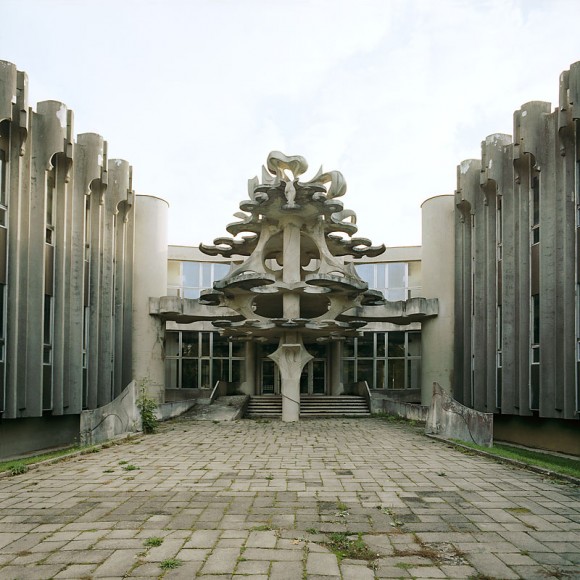
One of the things I enjoy about the blog is the chain link affect, when folks share related/inspired items after a post, and when previously encountered tidbits nest nicely with a current musing. A friend brought up Polish artist Nicolas Grospierre's work after the Sonsonate post and my mention of Frédéric Chaubin. I hadn't been familiar previously, and I love his work—so happy for the introduction. In addition to many bittersweetly striking projects, such as featured below, Grospierre made a gift of a photo of a patinaed wall to a writer friend, to serve as inspiration. You can see The Writing Wall on his website, along with his reasoning for choosing the image.

Photo from the project Hydroklinika, Nicolas Grospierre.
Grospierre's description for the Hydroklinika project:
The balneological hospital of Druskinnikai in Lithuania, designed by A. and R. Silinskas was built in 1976-81. Having served for merely 20 years, it was shut down and destoyed in 2005, to be replaced by a (probably more) profitable water-amusement park. Hydroklinika is an attempt at documenting the hospital through a global, objective and systematic approach. Therefore, no part of the building, was neglected and all were photographed likewise.
Before I started putting up the pics from Central America, my dad shared a link to an Alan Taylor/In Focus piece in The Atlantic featuring fantastic photos of North Korea by David Guttenfelder.

Original caption: "A statue known as the Monument to the Three Charters for National Reunification, which symbolizes the hope for eventual reunification of the two Koreas, arches over a highway at the edge of Pyongyang, North Korea, seen on April 18, 2011. (AP Photo/David Guttenfelder)"

For me, this arch is another example of the architecture of hopeful aspiration that pops up all over the world—on one level all tingly-cool, regardless of the all-important technicalities that are the original purpose, message, inspiration.

In Antigua sacred/religious architecture stands out. (More pics next post.)

Cross, Antigua.
I like the little clump of vegetation growing on the right arm of the cross. At full size, you can make out the very delicate detail of the plant life, in a nice contrast to the very bold lines of the cross and its ball base. Clumps and patches of vegetation, often flowering, affix themselves to all the walls and stationary objects in Antigua. The color and contrast in this picture have not been touched; the sky is a typical, dramatic Antigua sky.

Tuesday, August 9, 2011

All Watched Over by Machines of Loving Grace


I finally watched the trailer for the BBC documentary looking at our relationship with computers, and other mammals, titled for Richard Brautigan's poem "All Watched Over by Machines of Loving Grace." My dad pointed me to it sometime back via Poetry's Harriet blog. The trailer transmits like a poem for me, a kind of video/film/poem amalgam I'd like to see (make?) more of.

Moth at bedtime, El Zonte, El Salvador
This is a bit fuzzy but if you look really closely the moth seems to have red-eye, which is funny. I took this pic about 4 years back, when we had the chance to stay with our friends in El Salvador for a glorious three week stretch. That night I was reading The Shape of Water, the first book in Andrea Camilleri's Salvo Montalbano series (I now have a "celebrity" crush on Luca Zingaretti's TV Salvo); I remember because the cover of the book appears in another, fuzzier photo of the moth. I wish I could have caught the sound of the ocean in the picture; reading in bed with the sound of the ocean washing around my consciousness is about as good as it gets.

Horse in a rainbow bridle, Chiltiupán, El Salvador
We've gone to the little mountain community Chiltiupán to walk around the steep streets, buy fresh cheese from townswomen carrying it wrapped in large leaves; we've also tagged along when our friends have had to take care of business there—trash collection, water bills, et cetera, as Chiltiupán is the municipal center in their region. Everybody stares at Kennedy, we think because of his height. It's friendly, with some very shy giggles and smiles from the children.

Monday, August 8, 2011

Sonsonate

We're going through our accumulated pics from trips to El Salvador and Guatemala. There's not a lot of colonial architecture in El Salvador—my eye really enjoys crumbling modernity in spite of the economic/social implications. Sonsonate, the euphonious name belies; it's a hot, gritty city with not much to draw those without business there. We've passed through numerous times and made a trip to see a fine Semana Santa procession; this building caught my attention. The building reminds me of (though not quite on par with) Frédéric Chaubin's photos of mind-tickling Soviet architecture, published by Taschen in CCCP: Cosmic Commuinst Constructions Photographed. I like the pigeon keeping watch in the upper hole-window.