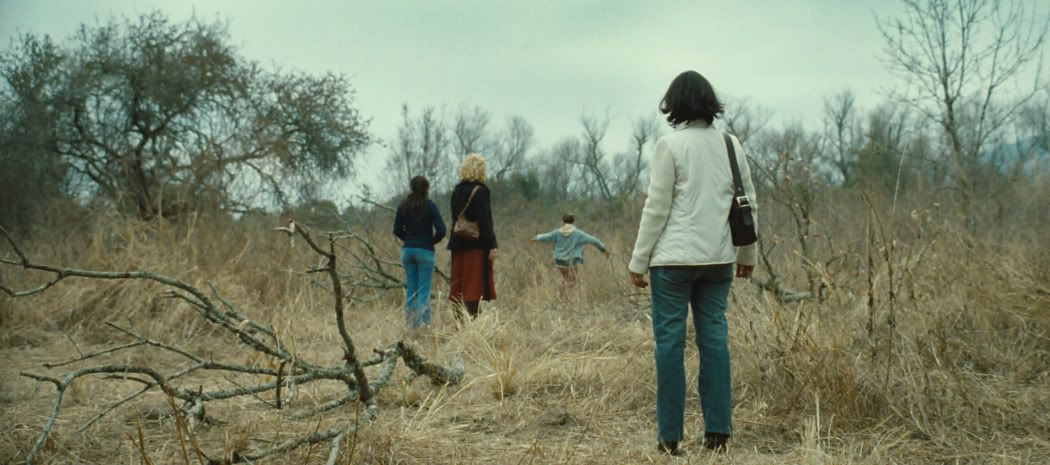
Turn your iPad into an avant gallery/library/listening station via UbuWeb, where you can watch experimental films, like Annika Ström's "All My Dreams Have Come True" (2004), above, in which her mother and uncle discuss how to say "all my dreams have come true" in English; and download super poetry, like Ron Silliman's "Sunset Debris." May all your electronic devices stimulate versus sedate (except when you are preparing for sleep, coming down from an anxiety attack, and other exceptions).
Recently saw Ron Silliman read at the Poetry Foundation. Best for hearing Ron read from "Sunset Debris," a long poem in questions. I went home thinking about crafting questions, and thinking about what happens in juxtaposing questions. "Sunset Debris" deftly had Kennedy and I in stitches, then pensive, inward-turning, then pulled us back out again, rolling us through a nuanced, diverse gamut of emotions and considerations, love, trash pick-up, sexual function and dysfunction, and other topics popularly and unpopularly handled via language.
I wish everyone in the world could write/dictate a poem in questions, and then all the questions could be compiled, into the longest poem in the world. What a collaboration. It would take a while to catch up with everyone, prioritizing folks on their deathbeds, so that their questions can be included, and finishing up with advanced and post-toddlers, whose iterations could provide crucial sub-volumes' worth of "why." (A real planning problem: where and when to end?) Even if the world population's contributions ran a single page per individual versus Mr. Silliman's fifty we would end up with a massively cool, endlessly intriguing document of human awareness in time and space. And someone or some people could spend the rest of their lives reading the global magnum opus.
"Sunset Debris" also got me thinking about blindness, blind poets, blind poetics. Wondering what the title would mean/feel to a blind reader/listener; and about the experiences of the blind reading/hearing poetry, sightless relationships with literary imagery, "Sunset Debris" relying less on imagery than many types of poems, but the magic of the title occurs in a brainswirl that includes visuals for me.
Thank you, Frame, for introducing me to one of the four corners of the earth, Fogo Island, and the Fogo Island Arts Corporation. The Arts Corp commissioned studios to house artists in residence and Norway-based architect Todd Saunders is doing a bang up job, perching mind-blowing little livables within Fogo's intimidating natural beauty. (If you enjoy architecture at all, be sure to check Saunders' other work on his website.)
The Bridge Studio, Long Studio and
Bridge Studio
interior are pictured
above.
Check the Arts Corp website to see more
studios
and past and current artists in residence.
Awe-inspiring, craggy, coastal, surreality-in-reality landscape? Check. Shelter as work of art? Check. Solitude? Remote-a-tude? Check. Unique local/international community arts interaction/collaboration? Check. Within hours of my first encounter, I started working on a project I hope to complete during a residency on Fogo. . . Poems about a place I have not visited, a series which I hope to complete by marrying them to poems written from that place at a later date. . .
In conclusion, I had to include "Parasitic Mind Control," as recommended by YouTube at the top of my search list of Annika Ström vids.
The Music Box Theatre teamed with the Film Noir Foundation to present the third annual Noir City: Chicago film festival August 12th through the 18th. The fest presents a lot of films unavailable on DVD, a boon for fans of the genre who have worked the home viewing catalog pretty deeply. It's so fabulous to see a noir film on the big screen in a restored print; I imagine that some noir films that have floundered for me at home would prove much more serviceable screened and viewed as intended.
I was able to make it for my top-choice double-feature bill: newspaper noir, both unavailable on DVD, and each centered on super leads, Alan Ladd and Humphrey Bogart.
CHICAGO DEADLINE screened once during the fest. When we arrived at the theater there was a line down the block. It reminded me of how it felt to see movies when I was young, before home viewing generally thinned the theater crowds. I try to see a movie or two at the int'l film fest every year, in part to tap into the same gathering anticipatory susurration. CD offered the gratifying Chicago backdrops the audience had turned out to see. Ladd did not disappoint, his charm-grounded-in-sorrow particularly apt for this storyline in which Donna Reed plays a nuanced noir role, the soft, doomed Rosita Jean D'Ur, a reversal from the roles I think of her in and in counterpoint to sparkling June Havoc who gets the happier ending here. Though some of the dialog suggests media critique (with unavoidable resonances with the current tabloid scandals), the performances riveted my attention in the characters' dramas and the newsie aspect of the film served more as fun trimmings for me.
CHICAGO DEADLINE, 1949, Director: Lewis Allen (thanks to retrografix blog for hard to find pics).
DEADLINE, U.S.A., directed by Richard Brooks, stars Humphrey Bogart as Ed "Hutch" Hutcheson, our editor-hero in an unabashed tribute to newspaper media. It's eerie to watch a "funeral for the press," made in 1952. In one shot, there's a sign posted in the printing room, visible behind Bogart/Hutch, that says something along the lines of: ""Newspapers Make Jobs" (I can't find a still or reference to get it exactly; should've jotted it down); this strand throughout contributes to the time warp effect that adds a layer of interest to an already engaging film. This is such a great Bogart role; it's boggling that this is not yet on DVD. My susceptible mind runs, momentarily, to kooky anti-media conspiracies. Ethyl Barrymore's media matron backs Bogart robustly and DEADLINE, set in Every-city, U.S.A., features a baddy politician Thomas Rienzi (Martin Gabel). Best editor versus mobster scene ever:
If you're interested in noir broadly, definitely check out the Film Noir Foundation. They offer a—now quarterly electronic—magazine with hooky articles, such as, The Heaviest of Them All: The Film Noir Legacy of Raymond Burr (on his baddie roles, pre-Perry Mason). The site also posts a monthly listing of Film Noir and Neo-Noir on TV. I dawdled posting, so I wasn't able to get this up before another great newsie noir screened on Fox: CALL NORTHSIDE 777, starring Jimmy Stewart and great views of the Windy City, based on a true story, and available via Chicago Public Library and likely through Netflix. Also screened on Fox this month (do we give Fox points for screening good noir?): I WAKE UP SCREAMING (1949), a really fun oddball noir (almost a musical noir, with a disconcertingly prevalent use of an "Over the Rainbow" instrumental) also available on DVD. So, good stuff on your telly. And save the dates for next year's Noir City fest! (This year a pass to see all 16 films went for an unbelievable $50.)
Given my penchant for print and justice, newspaper noir holds a lot of extra charm in an already fave field for me. I am guessing that with restored film prints now, we'll see CHICAGO DEADLINE and DEADLINE U.S.A. on DVD soon. In the meantime, Robert Feder created a shortlist of newsroom-centric flicks for TIME OUT CHICAGO last year; many of the films are noir; most are accessible now.
I finally watched the trailer for the BBC documentary looking at our relationship with computers, and other mammals, titled for Richard Brautigan's poem "All Watched Over by Machines of Loving Grace." My dad pointed me to it sometime back via Poetry's Harriet blog. The trailer transmits like a poem for me, a kind of video/film/poem amalgam I'd like to see (make?) more of.
Moth at bedtime, El Zonte, El Salvador
This is a bit fuzzy but if you look really closely the moth seems to have red-eye, which is funny. I took this pic about 4 years back, when we had the chance to stay with our friends in El Salvador for a glorious three week stretch. That night I was reading The Shape of Water, the first book in Andrea Camilleri'sSalvo Montalbano series (I now have a "celebrity" crush on Luca Zingaretti's TV Salvo); I remember because the cover of the book appears in another, fuzzier photo of the moth. I wish I could have caught the sound of the ocean in the picture; reading in bed with the sound of the ocean washing around my consciousness is about as good as it gets.
Horse in a rainbow bridle, Chiltiupán, El Salvador
We've gone to the little mountain community Chiltiupán to walk around the steep streets, buy fresh cheese from townswomen carrying it wrapped in large leaves; we've also tagged along when our friends have had to take care of business there—trash collection, water bills, et cetera, as Chiltiupán is the municipal center in their region. Everybody stares at Kennedy, we think because of his height. It's friendly, with some very shy giggles and smiles from the children.
With a few weeks recently laptopless, I've been on a wee technology diet. Not quite a full sabbatical/sabbath/blackout, but off the computer more—thus off blog. Now I am reentering the sphere, gearing up for the new machine.
This past week I saw a restored print of Nicholas Roeg's The Man Who Fell to Earth at the Music Box, on the tails of Argentinian director Lucrecia Martel's The Headless Woman, which I watched via DVD, having missed it at the Film Center—drat!
Two beautiful, morose films, not for everyone. I have a dear friend who walked out of Jim Jarmusch's The Limits of Control and I can only imagine that these would drive him off as well, along with numbers of other worthy viewers. These pictures are for folks who sometimes like their films straight up. Very little sound, dialog, action (though occasional potent bursts of each). Washes of gorgeous frames, visual prompts cue a viewer to feel through to the substance.
Original Movie Poster: There's a strange similarity between the two, huh? . . .
Stunning!
The "teaser" poster most associated with Roeg's film is very strong but can't edge this one out for me. I saw the poster for The Headless Woman at the Siskel Center and I had to see the movie. The Headless Woman takes this category.
Star: Bowie was a first love of mine and is stellar as the hapless alien humanoid in TMWFTE, Thomas Jerome Newton. Roger Ebert gives the film a thoughtful, fair review for the release of the restored film and nails it with kudos to Bowie as Other. Genuinely moving moments in the film derive from Bowie's delicate alienesque beauty. In an amazing scene early in his relationship with Mary Lou, she totes him along to her church and Bowie's alien "attempts" to sing along as the congregation shakily offers up an old English hymn in his honor (how funny/odd to watch Bowie effectively failing to sing well); we are first embarrassed by Mary Lou, the congregants, our fellow humans proffering what seems a bit of a podunk gesture to the sleek visitor, then we are ashamed at our own first reaction when we see him accept the moment fully and with grace, smiling humbly during his mumbly attempts at the tune.
Maria Onetto's Verónica is riveting in THW, conjuring the intensity, at a very low volume, of Gena Rowlands's work with Cassavetes.
My heart wants to give it to Bowie but I have to call this a tie.
Color: Bowie's color is fascinating in TMWFTE. Candy Clark's Mary Lou gets some very striking outfits. Garish flair transmits the simultaneous charm and awfulness of the native culture. Then the landscapes are a little washed out in a way that hints forward toward a less than rosy future. Overall the use of color in Roeg's film is transfixing. The color in Martel's film is equally effective and eye-catching, classier, muted like an old polaroid, and similarly matched to the story and conveying pitch perfect tone. Tie.
The dusky palette of The Headless Woman reminds me of some Tarkovsky.
Sex: Roeg directs scenes in TMWFTE that are really rowdy/randy and anchor the story in the earthiness that is, perhaps, at question. Even the "alien sex" we see (via Newton's memories? thoughts?), when Newton "comes out" to Mary Lou, also works to illustrate the power and oddity that are desire; and the strong bond that we share as creatures who desire. The Bowie/Clark relationship is an achingly potent portrayal of the familiar conundrum: powerful love/desire are also characterized by fragility. In THW, sex is utilized minimally in a way that works psychologically. TMWFTE takes this one hands down.
Bowie and Clark, odd couple with compelling chemistry.
Big Screen v. Small Screen: See TMWFTE on the big screen; both Kennedy and I realized we had each individually fallen asleep during past efforts to watch the film at home on television—it doesn't work on the small screen! THW is a tightly confined story and works at home on DVD; the visual beauty still translates and impresses. I have to call this a neutral b/c I can't fault a film for only working on the big screen.
NOTE: The new print/release of The Man Who Fell to Earth will be making its way around country. It's in Philly now, and it's hit NY, LA, Chicago, and D.C. already. Schedule here.
Morosity: TMWFTE offers up a many-layered view onto the sad side of the stranger in a strange land storyline, à la Werner Herzog's Stroszeck (they were originally released in 1976 and 1977 respectively). Failed love, the betrayal and loss of family, fecklessness, and reliance on gin; TMWFTE is so fetchingly shot and imbued with life and yet one leaves it woozy with sorrow. THW tackles lead character Verónica's catatonia after she believes she has accidentally killed someone in a road accident that she fled; friends suggest she only killed a dog but Verónica is convinced of her guilt, though unable to confirm who or what was killed. Verónica, a member of the wealthy elite, is surrounded at all times by the country's indigenous poor, and their relations form the foundation for the film's psychic unrest. It's a brutal scenario and one can't help but get wrapped up in the "what if." Lean over to grab a cell that's ringing and life changes, ends. And then, if you're one of the privileged few, it might, much to your dismay, just start up again like nothing ever happened.
Tie.
Director: TMWFTE inspires me to embark on a midsummer's Roeg-a-thon. THW is the work of a female director, still all too rare. THW gets it b/c there are too few auteuresses.
Linger Factor: With The Man Who Fell to Earth I wanted to get rid of any sense of time, because it's surprising how often we mention it in our lives. One thing got by me until the cutting – I suddenly heard someone saying 'I've been here three months already.' I thought, 'How did that get in?' I had to dub it." —Director, Nick Roeg, Interview SFX Magazine, August 1999. I've been walking around thinking about this film, a lot. Having just read this interview, I think perhaps Roeg in fact achieved a sense of timlessness that elevates the film above many of its peers. The Headless Woman is a really, really good film. So, so, so, so good. I think I partly think about it less now because it's scope is tidier; it's more pinned down. This is not a fault, but ultimately the stickiness of The Man Who Fell to Earth vaults it up into a tippy-top-tier echelon for me. . .
And the Winner Is: The Man Who Fell to Earth. I figure I have to give a winner after such a monster post. But if you haven't, definitely see them both! (Unless you dislike quiet, slow, moody, "taut" films.)
Both films recall Antonioni for me, making me feel warm and fuzzy in spite of my unease.
Koji Yakusho as Shinzaemon Shimad, before the action, 13 Assassins, Takeshi Miike. Photo courtesy of Magnet Releasing.
atmosphere:
Love the dark opening interior sequences in 13 Assassins, use of shadow à la Ozu. Beautiful tableaux too. The battle is staged with all the right rooftops, gangways, et cetera, but it was sooooo long, I started to think, "Wow, they really used a lot of wood." Which is to say that at a certain point the atmosphere suffered for me as the battle ground on.
I thought the Hughes twins' The Book of Eli looked great, in terms of post-apocalypse. (Kudos to Don Burgess.) More effective for me than the moister overcast of The Road. I have an abiding fear of exactly this kind of dryness. I guess it comes from growing up in L.A. (Note: the cannibalism strand is much scarier in The Road; it did not play for much effect here.)
Both film visuals are pretty top notch, though neither creates a new visual world. Miike's film offers more unique images, such as the still above, so I'll give it to Miike (and DP Nobuyasu Kita).
heros: Koji Yakusho (follow this link to see a history of his hairstyles on a fansite) is so handsome as Shinzaemon Shimad, the unflappable samurai who takes up the gauntlet and assembles the bakers dozen to bring down the grostesque half-brother of the shogun. I loved Yakusho in Kiyoshi Kurosawa's Charisma and Cure. He really is magnetic.
Koji Yakusho in Shall We Dansu?, Masayuki Suo, 1996. I really have to see this.
Denzel Washington's Eli is nicely, sensitively super-understated. We literally get no backstory, and yet Denzel's quiet charisma is intense enough to pull me through the movie.
It's a draw.
baddies:
The 13 Assassins baddie is guilty of "Total Massacre" several times over. Is Goro Inagaki's Lord Naritsugu (according to the site I've linked, the actor's blood type is O) unbeatable because he cut away the limbs and tongue of a poor village girl, enslaved her, and then discarded her? No . . . for some reason the actor just doesn't scare me enough to win this one.
In The Book of EliGary Oldman's deeds are, perhaps, less over the top, but he rises to the level of the Lord Naritsugu in creepiness via lording over his blind mistress and pimping out her daughter. The scene in which Oldman's Carnegie shampoos Jennifer Beals' hair (with, possibly, the last bottle of shampoo in the world, travel-sized), becomes surprisingly unsettling when their relationship is then clarified.
These guys are both pretty bad, and while I have to give it to 13 Assassins for the bad deeds, it's easier to sink your teeth into Carnegie. Draw.
blades:
One point to 13 Assassins for quantity, the alleys and roadways are studded with swords, stuck into wooden walkways and the ground for easy access . . .
However, I give one point to The Book of Eli too; for some reason, Eli's blade is, simply, effective.
Draw. (I feel like I should make a swordplay pun here but I can't come up with a good one.)
surprises: 13 Assassins elicited appreciative laughs with enraged black boars bearing fiery "backpacks" through the passageways of the "death town," scattering Naritsugu's guard.
In addition to a small appearance by Tom Waits, which is always a pleasure, The Book of Eli takes it with the dusty ipod that appears as one of Eli's prized possessions in the early establishing scenes; questions regarding the feasibility of keeping it powered linger, but it's such a cool "the new thing is the remnant old thing" moment. Maybe this scene is old news but it was new to me . . . What an awesome combo: we get Denzel tending to his weapons to the sound of Al Green's How Can You Mend A Broken Heart, which he is listening to on his headphone. This scene just works.
This "video" just features a static still from the scene but if you go here you can watch the whole scene.
venue: 13 Assassins at the Music Box Theatre. The Book of Eli on my couch.
Sorry, couch, I've got to give this one to 13 Assassins.
So, I guess we actually have a winner!
Though on a feeling level, I'm torn, since the venue was the tiebreaker. . . But then, I didn't touch on the much discussed problem that was Mila Kunis's part in Eli. Loved her in Black Swan, but here her characteristic earthy charm just doesn't fit.
This morning, looking at recent lithographs of Chilean artist Claudio Bravo (1936 - 2011), I see gentleness in the faces and forms of the animals, in the skulls of animals. It corresponds with the feel that carried Werner Herzog's recent Cave of Forgotten Dreams for me.
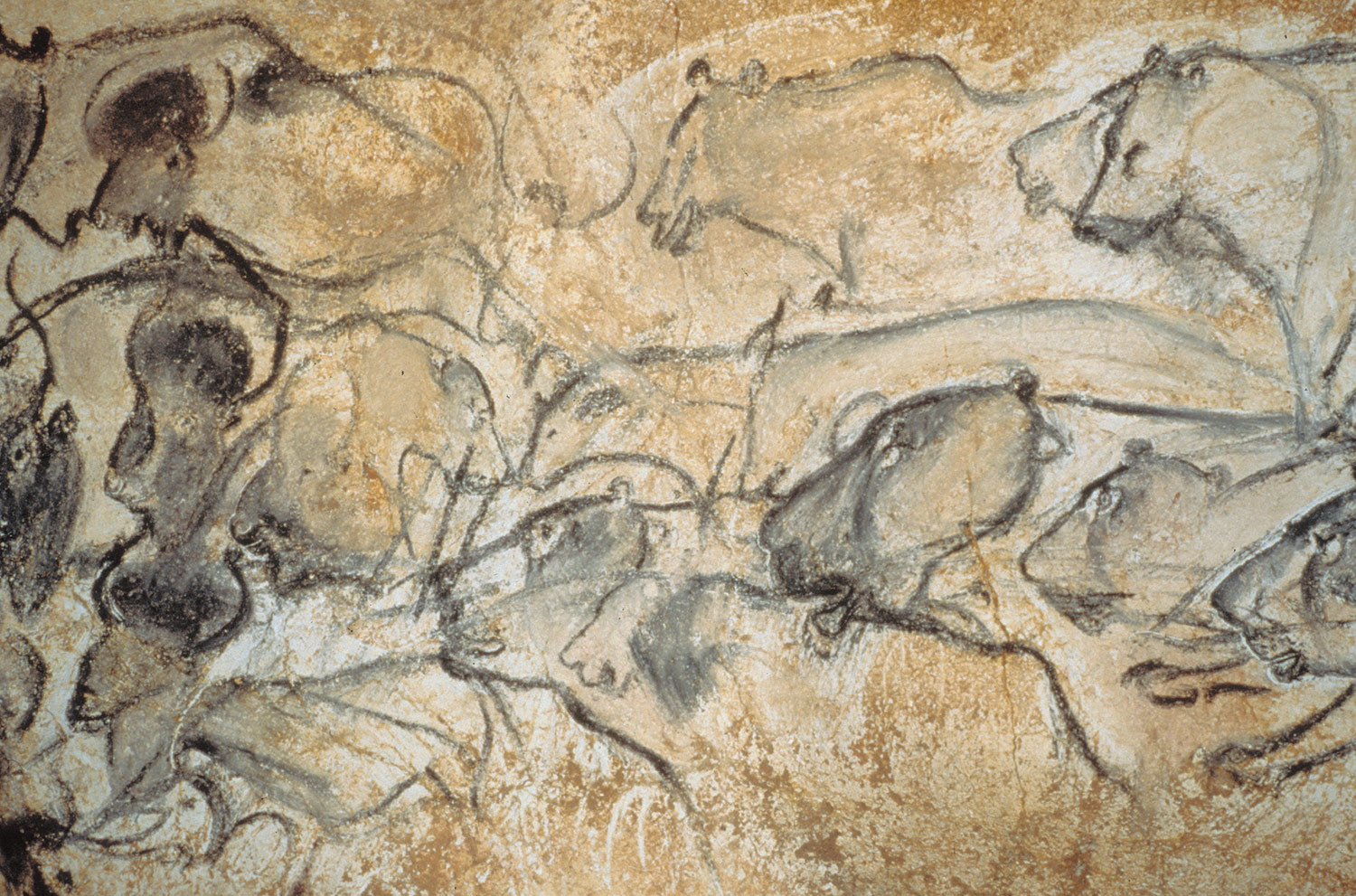
In the Chauvet cave art represented in the film, I don't see the teeth of the animals, the claws, the violent capacity of the hooves. Expressive eyes, mouths, faces conveying a variety of states dominate—delicately, gracefully extending from massive, supple and powerful bodies rendered in lines that suggest sheer admiration and even adoration. The cave experience seems to encompass a record of a "family of beings," and with just a barest imagination of life in such an icy, perilous time, I am amazed to find in the faces of a pursuing pack of lions, simply raw hunger, and perhaps excitement, none of the terrorous features we ascribe to predators today.
(They look like my cats at the window, mouths open in the weird gurgling song of prey sighted.)
This is not the finest, most beautiful example of the art in Chauvet cave, but I love the sketchbook quality, which, it has been observed, conveys numbers and motion here, as in other similar areas—I can't help but also see an artist in pursuit of "just the right expression" for the faces of the big cats.
I took a week to let the film sink in, avoided talking about it (mostly); avoided reading reviews. I'd gotten wind of the fact that some folks were disappointed. And to be fair, I am a total Herzog convert. I have enjoyed every Herzog film I've seen for many years. And I guess I haven't seen any that I haven't enjoyed.
While I was watching the film, and since, I've felt so relieved that Herzog is the filmmaker who was given access to the cave for filming. His work may not be associated with delicacy, but I see here, and throughout his films, a depth of appreciation for human experience that allows him to gather even the most seemingly extreme examples of our lives "under the same umbrella." Herzog's characters, often "real people," are not portrayed as exceptional, or, perhaps more accurately, they are portrayed as examples among the exceptional multitude; fascinating, flawed, capable of twists and turns and feats that stretch our minds and even our imaginations when we take the role of observers. Pilots, explorers, immigrants, bear-lovers, and now, paleolithic man.
I've still not read the reviews, except that I finally read Mark Doty's thoughts on the film this morning on his wonderful blog, feeling I'd given my own experience time enough to seep fully in (Doty's work was an early inspiration and continues to urge and inspire, and, ah, those we admire can so powerfully influence opinion). For me, what elevates Cave of Forgotten Dreams beyond simple presentation are the scenes that let the talking heads meander a bit, come to life, evoke curiosity on their own behalf. The evidence is in, the Chauvet animals touch viewers millenia hence; for me, Herzog's handling of the scientists, historians, et alia lifts these, our contemporaries, into a counterbalance across time to share in the mystery—who made the paintings? how many? why? we know there was fire, did they sing? And then, does the juggling archaeologist always dream? Does spear thrower Jean-Michel Geneste garden? (We see him out of doors a lot, and for some reason I see him as a gardener.) Herzog niggles a bit, digs a bit, and suddenly a flash of personality radiates from his lovely little array of modern sources. Herzog slogs through any awkwardness to allow the resonance. One of Herzog's powers is to blast by any worries of awkwardness.
Whether or not I agree with Herzog's suggestion that the Chauvet art represents a manifestation of the birth of modern man's soul, in my daily struggle with misanthropy, in Herzog's film I take a tonic that reminds me of an arching sweetness in our species' arc, that at the very least must weave in and parallel some of our darker propensities.
Final note: I have hereby memorized the html code for my beloved em dash: —