Showing posts with label books. Show all posts

Tuesday, January 10, 2012

The Joy of Books, How to Avoid Huge Ships


Book designs by
Rodrigo Corral, above,
and Chip Kidd, below.
Everyone is tweeting the "Joy of Books" video today and it feels like it should have a place here. A husband/wife team live-animated the shelves/stock at Type Books in Toronto.  The piece showcases the eye-candy quality of a room full of good print. And it is always fun to find a new bookstore. Now I have a bookstore to add to my list of destinations for an indeterminate future visit to Toronto. I hope to make it to the Toronto International Film Festival (TIFF)  some year sooner than later. My entire previous Toronto experience comprises one night passing through, feeling lost after a few days in orderly, showy Montreal; still, we managed to find a great meal in one of Toronto's Chinatowns, and stumbled onto a free Lila Downs concert at the Toronto Harbourfront
Centre
. Then we slept in the van.

A congruence of animations, animated books, creative couples, and our old friend book design: Last night I was finally introduced to Marcel the Shell With Shoes On. Somehow I missed it while 15 million + others were melting in the face of monumental cuteness. If you're like me and you're late to this party, watch adorable Marcel now!!! Marcel might even be certifiably poetic (in my book): "Guess what I use for a hat? A lentil." The word "lentil" is almost a little, round poem unto itself. And maybe the thing we call "lentil" is too.

Naturally, I looked up the people responsible. "Co-habitating couple" Jenny Slate and Dean Fleischer-Camp created Marcel together, and on filmmaker Fleischer-Camp's website I noticed he had directed an intro for comedian Patrick Borelli's one-man multimedia show, "You Should Judge a Book By Its Cover." Borelli, a former book designer, critiqued bad book cover design for laughs; he conceived the show for a library audience in 2009 [sic?] and took it to American Institute of Graphic Arts (AIGA) conferences across the country. The intro didn't do much for me (perhaps my expectations were too high coming straight off The Shell) but a cool interview clip from Borelli's show (also directed by D.F.-C.) features author/artist/designers Steven Heller, Rodrigo Corral, and Chip Kidd, and the covers selected and comments from the designers evidence the subjectivity involved in pinning down "bad," let alone "good."

In an A.V. Club interview with Borelli, the much-mocked How to Avoid Huge Ships is singled out to exemplify bad bookdom. I found myself taking issue with this particular skewering. There are so many jokes about this book afloat on the internet that it's difficult to find serious references. I get it. But, I thought, if there's a book about it, maybe avoiding huge ships is actually pretty difficult, once you're in a situation where such action is necessary. And if so, then I certainly want the person responsible for keeping me out of collision with a huge ship to know exactly how to prevent the disaster. The cover design is not that bad. Plebeian. Unsurprising. I've seen worse. Okay, I might even feel attracted to it. (At any rate, I hope that author Captain John W. Trimmer benefited in some way from the maelstrom of fun-poking.)

Borelli suggests that a bad concept makes a book design bad, but the two are so different to my mind, although related in a stimulating way in the best books as objects. I have personally owned some pretty bad books, in terms of content, that were just so great to look at that I got suckered in. And then, who are the concept police? In the Borelli/Heller/Corral/Kidd video linked above, Cooking with Pooh is brought out for discussion; I was glad to hear Heller back the idea that the book, though provoking, of course,  chuckles in the adult demographic, is probably effective in reaching young Pooh-lovers.

At the end of the day, I do love what Borelli brings up in his own interview and the interview with other designers, about picturing all the parties involved in publishing a real stinker okaying the really sucky cover/book design. Just last night we were talking about television ads, the good and the ugly, and the corollary visualization in which I picture a group of decision-makers sitting around a table, agreeing, "Yeah, we'll go with that one." Such as the one that could turn a true Pepper off Dr. Pepper forever.

Sunday, December 18, 2011

Twelve Days of Christmas Books: Big Books, Cookbooks

Matt Kish, illustration for page 357 of Moby-Dick; or, The Whale, from his book
Moby-Dick in Pictures: One Drawing for Every Page, October, 2011, Tin House Books.
When I worked at The Bookworks we had a regular customer who came in for big books only. He called in advance and we set aside stacks of larger-than-average books in all categories. Photography, art, cooking. Gardening, exercise, film. Compendiums (big compendiums only). The selected big books were taken abroad for our customer's foreign customers, all of whom were looking for big American books. (If you're in Chicago, Bookworks is a great stop for Christmas shopping—great deals on recently released books in perfect condition,  classics and oddities of all description, a careful selection of books big and small.)

I was just in The Book Table in Oak Park and had to exercise great restraint to keep myself from "picking up" Matt Kish's Moby Dick in Pictures: One Drawing for Every Page. This book is now on The A List. What a fantastic, imagination-tickling, satisfying book. This big beauty would be a perfect gift for artists, sure, and for fans of Melville, literature generally, illustration, art, design, process, personal challenges. This book will delight a motley yet sophisticated lot of folks. The trailer from publisher Tin House gives a tasty taste:


Kish's undertaking is the fruit of an ambitious self-generated art prompt, and the proof in the prompt pudding. Prompts are just ideas laid out like scaffolding and this is the kind of project that can niggle a lot of fellow artists/writers toward conceiving some tapping framework to encourage the creative sugar sap to flow. Though not evidencing Kish's fab use of color, the image below is one of my favorite illustration/quote pairings, not in the least because it selects such wonderfully poetic lines to sketch (there are so many cool drawings, so there are lots of favorites):


"But far more terrible is it to behold, when fathoms down in the sea, you see some sulky whale, floating there suspended, with his prodigious jaw, some fifteen feet long, hanging straight down at right-angles with his body, for all the world like a ship's jib-boom." -Moby-Dick, Herman Melville. Page 322 Artwork by Matt Kish.

If you're not close to Oak Park's book Table, you can order Kish's leviathan direct from Tin House as well. And check out Kish's website, blog, and Etsy shop for projects, his notes on process, and wonderful art for sale at incredibly low prices. I was reading some of Kish's blog before posting on this and particularly enjoyed his posts on book covers (appearing first on the Tin House blog). Kish's love of vintage mass market fantasy covers comes through in the Moby-Dick illustrations. I love that his Dec. 16 post touts one of the H.P. Lovecraft covers that Annie Heckman included in her contributions to the Chicago Publishes What Makes a Beautiful (and Marketable) Book? forum I wrote on recently (I highlighted two of the other Mountains of Madness covers Heckman showed; Lovecraft obviously inspires visual artists).

I've run the clock down so my 12 Days of Christmas Books posts will serve multiple/overlapping category offerings these days. . . .

Also tempting at The Book Table, India: The Cookbook, the fourteenth cookbook authored by Professor Pushpesh Pant, is an appealingly big book in its own right, packed in a printed, rice-carrier-style bag. With heft and the great design that characterizes publisher Phaidon's catalog, India: The Cookbook covers all of India's diverse cuisine regions and compiles Pant's twenty years of culinary research. (Cookbook, big book, compendium.) The book garnered the award for 'Best Indian Cuisine Cookbook in the World' at the 2011 Gourmand Cookbook Awards.


Pant's newest also shared the NYT's list of the year's best cookbooks with At Home with Madhur Jaffrey. I have a few Indian cookbooks and like to cook Indian somewhat regularly. I've turned to my text-only Madhur Jaffrey's Spice Kitchen: An Introduction to Indian Spices in 50 Simple Recipes nineteen times out of twenty over the course of the last twenty years when cooking Indian; I usually require pics, but this little sampler has me and my other very fine Indian cookbooks sit on the shelf, perfectly clean, virtually unused. I have given Jaffrey's cookbooks as gifts many times. One friend still thanks me for his Jaffrey cookbook eight years later. So, experience tells me that I don't need a new Indian cookbook. Still, India handsomely commands immediate "must-have" status.

Fish in Red Chili Chutney, India: The Cookbook (via http://www.indiawest.com)


The IndiaWest online community Web site features a few recipes from Pant's India; if you're finicky about cookbooks and not drawn in by looks alone you can try one or two dishes before committing. Make a warming winter fish dinner, using Great Lakes whitefish:

Fish in Red Chili Chutney
Origin: Coastal
Preparation time: 25-30 minutes, plus standing time
Cooking time: 15-20 minutes
Serves: 4
Ingredients:
1 lb 10 oz skinless, firm white fish fillets, trimmed
1 tablespoon vegetable oil
salt
For the marinade
1 level teaspoon ground turmeric*
4 cloves garlic, crushed
1 tablespoon lime juice
½ teaspoon sugar
For the red spice paste
6 dried red chilies
1/3 cup dried flake coconut
1 teaspoon malt (white) vinegar
* turmeric is a spice made from the rhizome of the turmeric plant, which is ground to make a bright yellow powder. It has a warm, dry flavour and is found in almost all curries and pickles. It also has antiseptic properties. 
Cooking Instructions:
Mix the turmeric, garlic, lime juice, sugar and a little salt together in a bowl. Put the fish in a large shallow dish and rub the fish with the turmeric mixture, then cover and set aside in the refrigerator for 30 minutes.
To make the red spice paste, put the dried red chilies, desiccated coconut and vinegar in a food processor or small blender and process to make a paste, adding a little water only if necessary. 
Heat the oil in a pan over high heat, add the red spice paste and stir-fry lightly for about 1 minute, ensuring the bright red colour is not lost due to browning. Reduce the heat, add the fish with ½ cup water, stir and simmer for 7-8 minutes, or until the fish is cooked.

Wednesday, December 7, 2011

Twelve Days of Christmas Books: Collectible


Visit Dawsons' Bookshop online for rare books, particularly art, photography, and So-Cal/Western Americana history, and for awesome fine art photography. Seriously cool stuff. If you are not sure what you're looking for, sign up to receive the Dawsons' emails right away and you will receive periodic highlights from the collection for sale (not too many and always intriguing; you'll be glad to find these in your inbox).

There are offerings to suit most wallets. From more humbly fascinating items like Marcia Rittenhouse Wynn's turn-of the century stories set in the Upper Mojave Desert in a first edition (1945) with a gorgeous screenprinted cover (above), to "the post-Provoke masterpiece of Japanese photobooks," Masahisa Fukase's Karasu (Ravens) (below).


Proprietor/curator Michael Dawson also offers museum quality art photographs. Photographers represented range from the iconic, including Ansel Adams, to deserving lesser-knowns. Currently the Web site features the Sanford H. Roth collection; Roth moved from New York to Paris where he fell in with and photographed the culturati who would become lifelong friends, including Colette, Picasso, and Cocteau. Roth went on to photograph film stars in Hollywood and Eurpope, becoming famous for his portraits of James Dean.

Bastille day parade - 1950-55. Sanford H. Roth

Tuesday, December 6, 2011

Twelve Days of Christmas Books: Photography

Timothy H. O’Sullivan, Black CaƱon, Colorado River, From Camp 8, Looking, Above, 1871, Albumen print, Library of Congress, Prints and Photographs Division. Check out the Art Tattler International Web site for a great preview.


Day one in twelve days of books from my wishlist.

Two gorgeous photography books available in the Art Institute gift shop, good for a destination shopping trip.

Check out the exhibit: Timothy H. O'Sullivan: The King Survey Photographs. Then pick up the book: Framing the West: The Survey Photographs of Timothy H. O'Sullivan for any fans of photography generally, history, Western Americana. General book and art lovers should find interest in O'Sullivan's photos too; much of his work finds men (and their essentials and accoutrements for survival and exploration) dwarfed within awesome, overwhelming landscapes, beautiful, certainly, and the images are charged with a current of foreboding. Both the "pure" landscapes and views incorporating the human form similarly suggest stories and spark the imagination.

You can order direct from Yale Univ. Press too.


Richard Misrach is a longtime favorite. Misrach's 2010 book Destroy This Memory looks at post-Katrina New Orleans. Misrach's eye is unique, his technique is dropdead gorgeous (let's just say he is considered responsible for "bringing color photography back"), and his subjects are meat and gristle, so his books are all substantial, worth the investment and deserving permanent shelfspace, as the images bear ongoing examination.

In his Modern Art Notes for the Artinfo blog, Tyler Green describes Misrach's gestalt for his Katrina book: "Misrach’s book focuses not on the totality of the devastation but on one way New Orleanians responded to it. . . . New Orleanians spray-painted messages on their homes, cars and propped-up boards of plywood. The graffiti are warnings, announcements, pleas and even sly jokes shared with neighbors, government, city officials and neighbors. They are among New Orleanians’ first written responses to their hell."

 
According to Green: "Misrach didn’t just make his pictures into a book, he printed them and gifted full sets of prints to five museums that serve as storehouses of our visual record of ourselves and our culture: the Museum of Modern Art, the National Gallery, the MFA Houston, SFMOMA and the New Orleans Museum of Art.  Misrach is also donating the royalties from book sales to the Make it Right Foundation, which is active in the Lower Ninth Ward of New Orleans. (Readers may also click here to give to Make it Right.)"

If you're not in Chicago, or you can't make a visit to the Art Insitutitue, Destroy This Memory is offered at a nice sale price via the publisher at: Aperture Foundation (while you're there, if you subscribe to the magazine, at a 50% discount, you get a free copy of Aperture's Masters of Photography series: Paul Strand with your subscription). 
“I’ve come to believe that beauty can be a very powerful conveyor of difficult ideas.”—Richard Misrach 
(If you do make it to the museum, you can always pick up a membership for someone you love, a year's worth of beauty and its effects.)


Sunday, December 4, 2011

Book Design Rising


On the front page of today's NYT Julie Bosman's "Selling Books by Their Gilded Covers" outlines the newly [re]trending wisdom that sees publishers making books more beautiful again as readers elect highly designed print objects in making print purchases. The photo accompanying the NYT article features Design Sponge at Home, which I picked up off a cart at the library yesterday, after it caught my eye with its clean red heft. I didn't take it home with me (even on loan) but I did file it away as a book to pick up in the future, and it only darted onto my radar via its physicality.

On Thursday I met folks from my writing group at an edition of the Chicago Artists Resource/At Work Forum hosted by Chicago Publishes: “What Makes a Beautiful (and Marketable) Book?”A panel comprising three professionals working in different areas of print publishing discussed the question of beauty versus marketability; though the discussion was framed to look at tension between the two concerns, the panel members pretty immediately established that today, due in part to competition from e-books/readers, "print design matters more than ever." Representing the marketing perspective, Ellen Gibson, Regional Marketing Manager at the University of Chicago Press was quick to illustrate this with examples from the UC catalog, from the ubiquitous Chicago Manual of Style remade to a sharp new edition of The Iliad. Jill Bough's Donkey, also pictured below, was not mentioned, but I discovered it on the UC site as they distribute the Reaktion Books Animal series. Love it. Now I can add all forty-seven heavily illustrated species-scopics to my wishlist, from Charlotte Sleigh's Ant to Garry Marvin's Wolf.


Gibson also discussed two very appealing illustrated guides to Field Museum collections of insects, spiders, and insect and bird architecture from Illinois, featuring paintings by Peggy Mcnamara.The two books are significant in that the slightly spendier hardcover second volume found more sales than the more affordable first volume, released with a handy flex cover common in field guides (both have now been added to my to-give Christmas list). 


James Goggin, designer and Director of Design, Print and Digital Media at the Museum of Contemporary Art here in Chicago projected a number of very cool covers from highbrow mass market editions of culture/media/art/fiction (now) classics sporting the sleek mod designs that keep people talking (and blogging) about them decades after.


Goggin used this edition of The Medium is the Massage [Smashing Magazine on McLuhan and the message today] as an example, along with a couple of Bucky Fuller books. He did not use Dreadful Summit, but I found it while I was poking around (amidst a nice collection of vintage Penguin and Pelican compiled by an Italian designer I don't know, Paulo Gabriel). Goggin's design for The White Boy Shuffle shows that his love of type and a classic era of book cover illustration pay off in the contemporary.

Though the inexpensive, highly portable editions Goggin is influenced by disappeared in the States after their heyday in the '60s and '70s, the Japanese mass market bunkobon format continues to thrive (typically used for novels). Goggin brought in an example, pointing out that the tiny book proffered both slipcover and built-in ribbon bookmark, and used a bunkobon edition of Yukio Mishima photographs as an example of the range of subject matter deemed appropriate for publication in the format. I couldn't find a good history/overview of bunkobon to link to, but I did find Obun Printing, a company that sells "Designer book covers: T-shirts for your books. . . . for small-format paperbacks (bunko-bon) and for slightly larger general-issue books (shinsho-bon)." Features listed on the website include: "our original emotional value printing." The Obun Web site is fun to explore; look for the monthly senryu.

Goggin quoted Clive Thompson and Charles Eames to the point:
We need to stop thinking about the future of publishing and think instead about the future of reading. —Thomspon, Wired, May, 22, 2009
I don't remember being forced to accept compromises, but I've willingly accepted constraints. —Eames

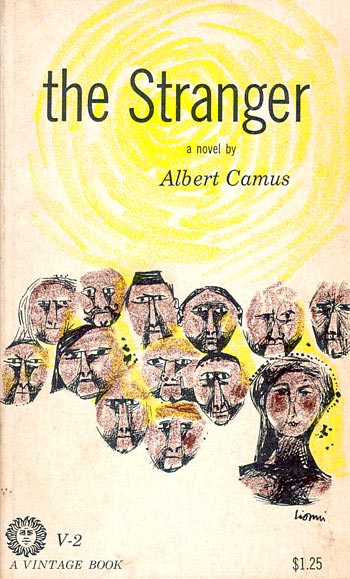
Annie Heckman, artist, book designer, and founder of Stepsister Press, started off talking about the use of a well-known paperback edition of The Stranger in the film Jacob's Ladder, to get at the idea of the individual bonding with books (and other objects) as a significant act of identity and connection. Then she showed a diversity of cover design interpretations. Heckman asked how many people in the audience had read The Stranger and I was surprised that only around half of the hundred or so bookish crowd raised their hands (maybe it was an issue of issues with hand raising?).


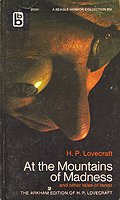
Next, Heckman went on to show an array of covers for H.P. Lovecraft's At the Mountains of Madness (see top) to the same point (I hope Guillermo del Toro gets to make his adaptation of ATMOM!). Going into the slide show Heckman asked how many in the audience had read Lovecraft, and my friend Ted and I raised our hands. That's pretty much it. It's hard to imagine that Lovecraft readers would be unwilling to "represent." I am only a mild fan, but by chance my group was to be looking at a rough draft of a new poem of mine titled "call of cthulhu" (about the strangeness of reading fiction about horrible incidents in order to escape daily life) later in evening. Possibly, this coincidence had shifted the balance of the universe and any small legion of fellow Lovecraft readers had been kept away lest the weight of us be too much. . . .

Stay tuned for my parade of mouth-watering Christmas-list books!

One of Heckman's animations, ruminating on a decomposing mouse, change in general, Becoming Formless (Heckman's animation YouTube channel):


Wednesday, September 21, 2011

Fruit of the Temporary Amazon Purchasing Hold

In terms of print, decided to limit myself to buying in bookstores, buying from publishers, and borrowing from the library, for now.

I can get quite a bit of good stuff via inter-library loan. Then, browsing for poetry in the library is not ideal, but it can bear fruit. Found and enjoyed Zach Savich's Annulments. The format and form are nice; the book's small and squarish and the poetry is sparse on the page (I'm thinking of a dwarf conifer garden, with perfect, sometimes funny, sometimes gorgeous little trees and plenty of open space for rocks or mulch in between), such as, set apart: "Car going faster or posts grown closer together. Men pronouncing the names of fish."

I particularly liked "Real Time," the end:  

Reading together is mostly looking up 

The world a more literal place in the morning 

Standing not with a loaf but the flour

Zach Savich, Annulments, UP of Colorado, 2010.

Sunday, July 31, 2011

Of Lamb, Cows, Ghazals, and Marianne: Summer Reading Miscellany

Recently acquired: a nice little stash of poetic fare, delightfully light but never cloying, anchored in the madhouse of love, bovine heft, ancient form, and good-byes.

Page from Of Lamb.
A collaboration between Matthea Harvey and Amy Jean Porter, I saw Harvey present this erasure poem with text culled from A Portrait of Charles Lamb (by Lord David Cecil) at the Art Institute as a part of the Poetry Foundation's Poetry Off the Shelf series. Harvey plays tenderly with the story of the lives of troubled literary sibs Charles and Mary Lamb, creators of the children's book Tales from Shakespeare. Porter colorifically illustrates. (As of this morning, Cecil's The Stricken Deer or The Life of Cowper is on my reading list—Cowper is a poet-to-whom-I-return, and what a title.)

The Cows
Lydia Davis's ruminations on the cows in the field across the road are the most relaxing morning's read in memory.


I workshopped with Ron Koertge in the early to mid-nineties. It was life-changing, finding his work, defined by fun and irreverence, and working with a skilled and bebooked poet and storyteller who'd left the cape of clicky self-importance at the side of the road in the mud where it belongs. Indigo, Koertge's uber-fresh cadre of 69 "bastard ghazals" read like minty spirited fizzy water on a hot summer's dusk.

Even cuter in the hand.

I love small books: pocket editions, micro fiction, the most petite chapbooks. I like the Everman's Library editions generally, big and pocket. I have most of Leonard Cohen's poetry in original editions and knew the poems before I first heard the songs. This duplicates a lot of what I already have, but I find it cool that RH is giving Cohen official canon status and it's really nice to read the great songs like poems:
Oh you are really such a pretty one
I see you've gone and changed your name again
And just when I climbed this whole moutainside
to wash my eyelids in the rain . . . 

Wednesday, June 15, 2011

Visual Paradise

"Art is a constant; it's part of you." Dennis Hopper

The Trib's piece on the Art Institute's new Taschen shop-within-a-shop quoted a consultant advising museums in matters of retail, "If you're in the middle of a whole bunch of Taschen books, you're in the middle of a visual paradise."

At Rizzoli in the mid-'90s we maintained dedicated Taschen tables, towering with  juicy, super-saturated tomes. Smart, bold catalog, it's no surprise they're still selling like hotcakes. And the company's got marketing panache to suit.

Mostly, yes, viva! Bookstores, adapt! Then, sigh, the "publishers with high wholesale prices" who didn't make the cut. Certainly some of their books are wonderful too, like endangered species. Even an ugly little biting beast is so important when it's almost gone.

Tuesday, June 14, 2011

Summer Reading, Category: Zombies

Publisher: Holt Paperbacks

Bring a lot of water; extra sunscreen and maybe even an umbrella and a light jacket.
You'll want to read this in one sitting. Or, if you must, on the train to and from your office.

If you like Southernisms and the Undead this is your jar of moonshine.

In case you like to read reviews first, the A.V. Club reviews here (non-lethal dose of apt critique).

Sunday, June 12, 2011

50 Watts' Polish Book Cover Contest

Singeon (Nicolas Gallet), second place winner


On Tuesday, my Dad sent me to 50 Watts' Polish Book Cover Contest. Most of the entries are pretty enticing. I keep going back to look at favorites and I have that covetous feeling that I get around certain books. . . . I cruised around the internet looking for the artist who designed the cover for an edition of Knut Hamsun's Mysteries that I find particularly compelling--uncomfortable/eerie, in an attractive way--which brought me to Milton Glaser. The search and its sallies landed me on his cover for a paperback copy of Dicken's Hard Times that's been floating around the house and which Kennedy read recently, and then back to a 50 Watts' piece on Glaser.

Nosing around 50 Watts, I noticed a quote from David Pearson, who commissioned some extremely moreish designs for White's Books' classics covers that caught my eye recently. Online book lovers have been vociferously aflutter.

Some of you know that I am working on a series of poems based around Gene Hackman's filmography. Occasionally, I allow myself to fast forward, really far forward. WIPs complete; the scores to be written are written (Antz and all). Daydreaming the cover is sweet. I toy with the idea of garnering use of a photo by Richard Misrach. Oh how I wish I could pop his Playboy #97 (Marlboro Country) in here for you to see, but I can't find a paste that seems kosher so you'll just have to visit My Future Cover Art at the gallery where it lives now via the link.

Then again, I'd love to throw the book to the eye-bending talents of a genius designer/illustrator to see a tasty new surprising concoction arise.